Apr 29, 2026 · 9 min read
On the origin of Manhood Performance Indicators (MPIs)
The moment our species switched from natural selection to cultural selection
By David Pedersen
The young boy puts on his pokerface, as the shaman ties the gloves tightly around his hands. Inside the gloves the sedated bullet ants, Paraponera clavata, are slowly waking from their slumber, angry and eager to sting.
For the next 10 minutes, the boy must dance and endure the venomous sting of the bullet ants. They are known as the most painful sting of all insects, and named so because the pain is likened to being shot.
The boy must endure this ritual 20 times. Only then is he considered a man, and able to handle the pain and responsibility of adult life, as part of the Sateré-Mawé tribe in the Brazilian Amazon.
Meanwhile, across the globe, couples’ therapists report that in most cases it is the woman who initiates the counselling, by dragging the reluctant husband to the session. And doctors report that men don’t come to the hospital unless their pain is very severe, which often leads to delayed and less effective treatment.
While there may be far from the airconditioned therapist’s waiting room to the humid hut in the jungle, they both share a common thread: men are conditioned to suppress emotional and physical pain as a condition of manhood.
1. The role of Rites of Passage for Manhood
The notion of manhood differs across regions and ages. Many cultures have their specific expressions of it. But what is more striking than the differences is the near-universal structure that it shares.
Manhood is a benchmark that we rely on so heavily to guide our beliefs and behavior. So it becomes important to ask: what are its origins? Is there some original root from which these different branches have sprouted?
And as we run our fingers through the pages of history to find the first splashes of ink that describe manhood, what do we look for? Do we look at the ancient cave wall paintings? Do we examine the victories and virtues of the mightiest heroes?
Alas, the trail goes back further than the first cave paintings. And the heroes merely embody the virtues to an extraordinary degree, but they didn’t invent them. While we may learn something from both, I believe it is much more instructive to look at the traditional rites of passage.
Humankind has used rites of passage to guide our transition through different stages of life. Think of the importance of weddings, baby showers, and funerals. They all signal the closing of one chapter of our journey, and the celebration or mourning of the next.
The traditional rites of passage of manhood mark the end of life as a boy, and the beginning of life as a man. You likely have some image coming to mind, possibly of a distant or ancient tribe where a young boy brings back the kill from his first hunt. Some of you might also think of a young western male chugging his first beerbong as the crowd around him goes wild. As we shall see, both rituals are more closely related than one might think.
Though they vary greatly in content, they all share the same basic formula: 1) At the beginning of his teenage years a young boy is taken from his family to be trained in the specific skills and role the community or tribe needs from a man. 2) He spends time training with other boys, under the instruction of older men, to become a hunter, warrior, forager or fisherman. 3) When he is deemed ready, he is sent out on a trial to test his skills. If he returns triumphant, he is granted the label of a man, and can access the privileges that come with it.
However, it is also possible for him to fail his shot at achieving manhood. In many cases this is not simply a matter of ‘re-taking the exam’, but has drastic consequences for the boy, such as being shunned from the tribe. How these ‘failures’ are dealt with holds a mirror to how many of our cultures view those who fall short of manhood.
2. The shift from Natural Selection to Cultural Selection
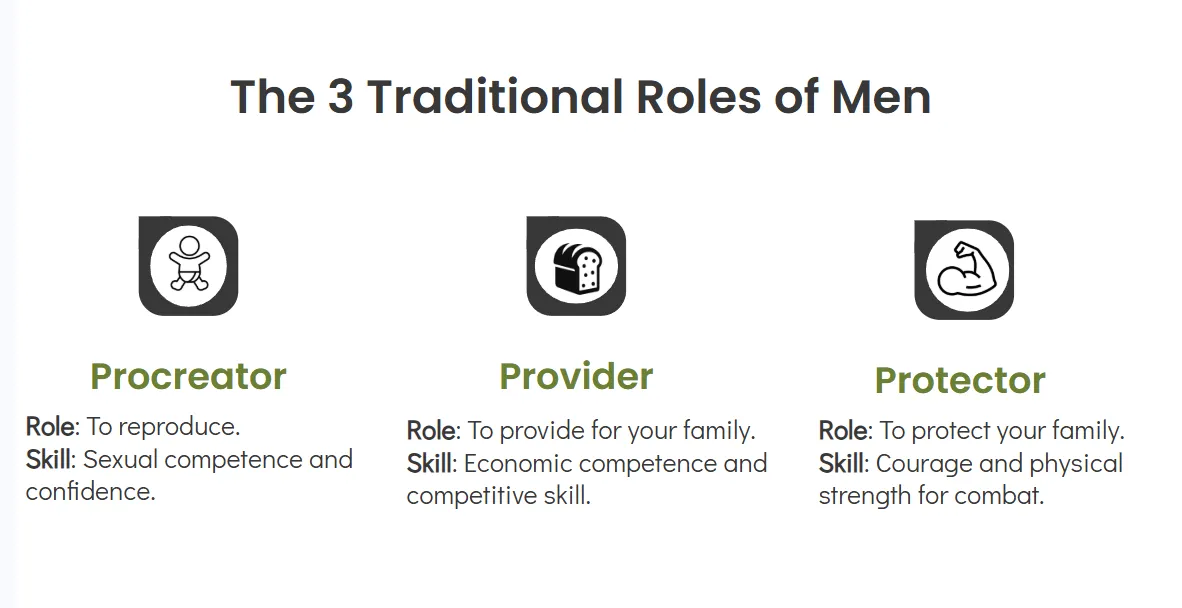
The primary roles of men have for ages been that of procreator, provider, and protector — and required the specific skills that come with it. How the expression of each of those roles looks in a specific tribe or community depends on the environment they live in, and how they nourish themselves.
But the underlying structure for each is that the society has a specific need, and the boys must be trained towards the role that fills it.
Manhood rites of passage signify a significant shift from natural selection to cultural selection. They are the first articulations of a culture’s attempt to create man in a certain image.
Cultural selection is a deliberate selection by society of what it has determined is necessary to survive in its surroundings. The cultural selection is of course rooted in biological needs. If our ancestors had not procreated, provided for and protected each other, no one would be reading this article. But, whether consciously agreed to or not, it is a convention.
Three other fascinating lessons stand out from the rituals.
Firstly, manhood is a performance. You have to act to achieve it, in a public display that proves you meet the requirements. In most cultures, it is not enough to say you are a real man — you have to prove it.
Secondly, the traditional, formal rites gave access to formal rights. They secured a man’s position and privileges in an established, formal manner. In most western cultures, in replacement of these traditional rituals, young men now seek out other acts of daring displays to claim their position and privilege, even though both are short-lived. Because it is so precarious, the performativity and need to assert has become much more constant in modern times.
Lastly, the rituals all center on what has been the roles of men for millennia: to procreate, provide, and protect. And each role has its own specific set of skills attributed to it. To procreate requires sexual confidence and competence. To provide requires economic competence and competitive skill. To protect requires physical strength and courage for combat.
These specific skills are the origin point for what I call Manhood Performance Indicators (MPIs). They are the benchmarks that measure how manly a man is.
Both throughout history, and in this present moment in time, the role of men has been changing rapidly. Yet the MPIs have remained largely unchanged. So while the roles of men are changing, much of the societal pressure still pushes them in the traditional direction.
This two-directional pressure is causing conflict in the identities of men. It questions their positions, their privileges and their purpose. This is the topic of the next article: “The Crisis in Masculinity & The First Rule of Fight Club”.